
Research
A laboratory
that sails.
L'Hydronaute is an onboard research platform open to researchers, laboratories and institutions. On every voyage, the boat measures, collects and documents — the data produced is versioned and destined for publication as an open dataset.
We are looking for scientific partners to co-build the measurement programmes. Research missions are offered at a reduced rate.
Research programme
Each axis carries its maturity label — proof before promise.
The HYDRO-RD-01 programme structures four axes of investigation, conducted simultaneously aboard the V1 demonstrator and on a small-scale autonomous mini-demonstrator.
- 01
Assisted navigation & onboard intelligence
Experimental
An autonomous mini-demonstrator (ASV), parallel to the V1 prototype, serves as the test bench for the assisted-navigation architecture. The ArduPilot/MAVLink software stack is developed and tested in a basin, then on the Erdre. Human navigation data collected through Trashure Island feeds a training corpus for future autonomous navigation policies via behavioural learning.
- 02
Reversible interface & retrofit method
Integration
How do you design an exoskeleton-to-hull connection that transmits propulsion loads with no permanent modification of the host boat? The goal is a documented method, transferable across several classes of river boats — from light launches to freight barges — with no heavy shipyard work or extended downtime.
- 03
Hydrodynamics & energy architecture
Integration
The floating exoskeleton adds non-trivial hydrodynamic resistance to the float/host-hull pairing. Characterising and minimising that drag, sizing the solar-battery-propulsion energy chain under variable load, and validating the extrapolation method toward larger boats are the three open questions of this axis.
- 04
Microplastics & water quality
R&D
L'Hydronaute carries a microplastic sampling and filtration system operating in real conditions on the Erdre. The collection protocol is aligned with reference work on continental sediments and Loire-basin river environments. Samples are accompanied by water-quality measurements (conductivity, temperature, turbidity) and biodiversity observations.
Protocols & programmes Claudia Rosales Research, biodiversity & HSE → the crew
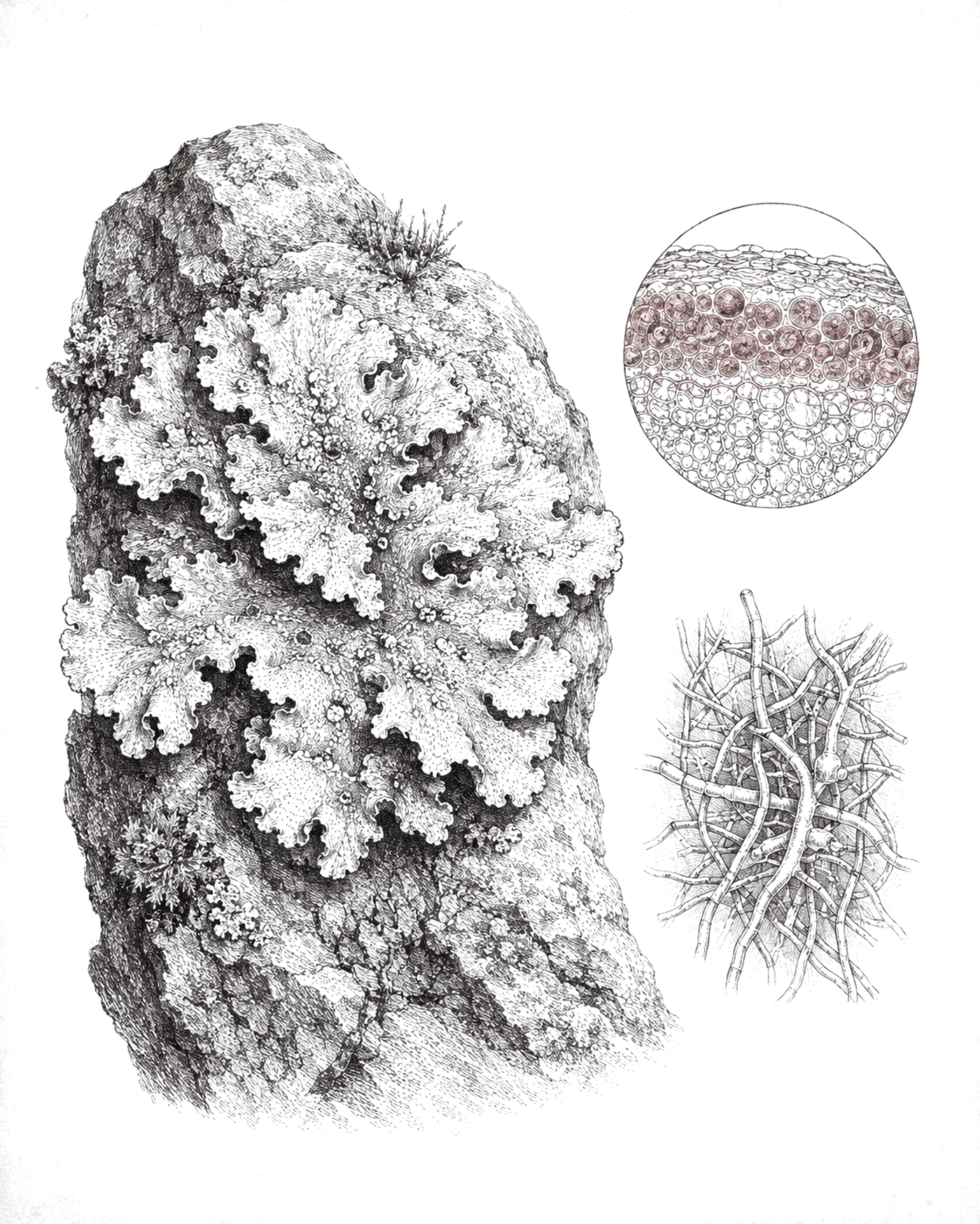
Plate · Symbiosis 05 · Lichen — alga & fungus
A lichen is not a partnership: it is two organisms — an alga and a fungus — become a single body, able to live where neither would survive alone.
Our research works the same way: science, engineering and design fused into protocols no single discipline would produce on its own.
Citizen science
Trashure
Island
From serious game to
citizen-journey training simulator
Born as a 3D navigation game in a steampunk river world — pilot, collect plastic waste, dodge pirates and their fireballs — Trashure Island is being transformed into a training simulator: the first step of the citizen-science journey, before taking the helm of the real vessel. The simulator keeps the spirit of the game — you learn better while having fun.
Beneath the playful surface sits a scientific layer: every game generates structured observation-action pairs documenting how a human makes navigation decisions — trajectory, avoidance, collection priority. These logs form the training corpus for future navigation policies tested on the autonomous mini-demonstrator (ASV), the test bench for the onboard architecture.
Game mechanics
- GoalCollect the most plastic before the clock runs out
- SurvivalHealth at zero = game over
- BoostTurbo Ram — triggers a charge
- ChargeFireball — hold, then release
- UpgradesModular exoskeleton selectable in game
Open dataset
Open baseline. Protected research. BIUTOPIC baseline data is meant to be open where it creates public value. Partner research teams' datasets remain protected. Operational telemetry and participant interaction data are kept separate and handled in accordance with the GDPR.
Georeferenced samples, filtration results, weather and hydrological conditions at collection time.
Publication planned late 2026UTC-timestamped ArduPilot logs: position, speed, heading, power, energy state. CSV + binary format, Git-versioned.
Publication planned 2027Observation-action pairs from game sessions. Documented schema, JSON examples, methodology README.
Publication planned 2027How the platform is validated before any campaign: criteria, exit thresholds, solo versus coupled comparison, classified failure log. Read the protocol
Published — v2.0, August 2026State of the art — the barrier is operational
Robotic platforms for water monitoring are not a new idea. The European project HydroNet (FP7, 2008-2012, €3.5M total including €2.6M of EU contribution, coordinated by Scuola Superiore Sant'Anna with ten partners) developed and demonstrated surface robots — including a catamaran — carrying heavy metal and hydrocarbon sensors, with field missions covering tens of kilometres.
That project's own reporting concludes that the prototypes proved effective for research but “lacked robustness for extensive operational deployment by environmental agencies”. Neither the science nor the demand was missing. What was missing was an agency's ability to actually run the platform day to day.
That finding shapes our work. If the barrier is operational, it is removed by method and by operation rather than by another sensor — hence a validation protocol published before any campaign, and a model where we operate the platform rather than deliver it.
Applications
Hydronaute is more than a boat: it is a field platform for developing, testing and documenting protocols replicable on other rivers, canals and coastal waters.
- Microplastics · sampling, filtration, counting and characterisation in river conditions
- Water quality · conductivity, temperature, turbidity, dissolved oxygen
- Biodiversity · bank observation, acoustic monitoring, species presence
- Solar navigation · real-world range validation, energy profiles, use conditions
- River retrofit · modular exoskeleton transferable to other existing hulls
- Open data · versioned datasets, metadata, progressive publication
- Assisted observation · onboard vision and AI to annotate navigation sessions
- Education & citizen science · workshops, schools, local groups, Trashure Island game sessions
- Aquatic animal welfare · exploratory research track, to be co-built with partner laboratories
The research team
The programme is run by a small team combining environmental research, machine learning and hands-on operations on the water. Fieldwork, instrumentation and analysis are carried out by the same people — which is what makes it possible to publish a method rather than an isolated result.
- Claudia Rosales · head of research, biodiversity & HSE. Trained at the Instituto Potosino de Investigación Científica y Tecnológica. She is preparing a doctoral project and is currently seeking a university partner for a CIFRE agreement.
- David Aznaurov · machine learning researcher, affiliated with the M:3L laboratory at the Institute of Mechanics (Armenia). His published work covers mechanical metamaterials and wave propagation in periodic structures (Google Scholar). At BIUTOPIC he leads the autonomy, point-cloud processing and satellite-calibration work.
- Elven Villecourt · founder, field operations and institutional relations. Head of Media at the Paul Watson Foundation UK.
- Arpi Mangasaryan · structural architecture and prototyping.
The programme's academic anchoring runs through the partner laboratory M:3L (signed memorandum of understanding, 2026), detailed below.
Scientific collaborations
The research programme is built on active academic collaborations, in France and internationally.
- M:3L — Mathematical Modeling & Machine Learning Laboratory · Institute of Mechanics, National Academy of Sciences of Armenia. Research in 3D — scene understanding and reconstruction —, satellite-data analysis and applied AI. Partner laboratory (memorandum of understanding, 2026).
Propose a mission
L'Hydronaute is open to researchers, laboratories, PhD candidates and institutions wishing to run measurements or experiments in a river environment.
- Platform access at a reduced rate for research missions
- Onboard sensors available (energy, navigation, water quality)
- Collection protocol co-built with your team
- Data produced shared under an open licence
- Field: the Erdre, Natura 2000 zone, 15 km between Nantes and Sucé-sur-Erdre