
Logbook Trashure Island · Game and research
Trashure Island: a game to understand how people steer
A steampunk river, pirates, three minutes to pick up as much plastic as you can. Trashure Island is a game — and a model to see how people react and steer.
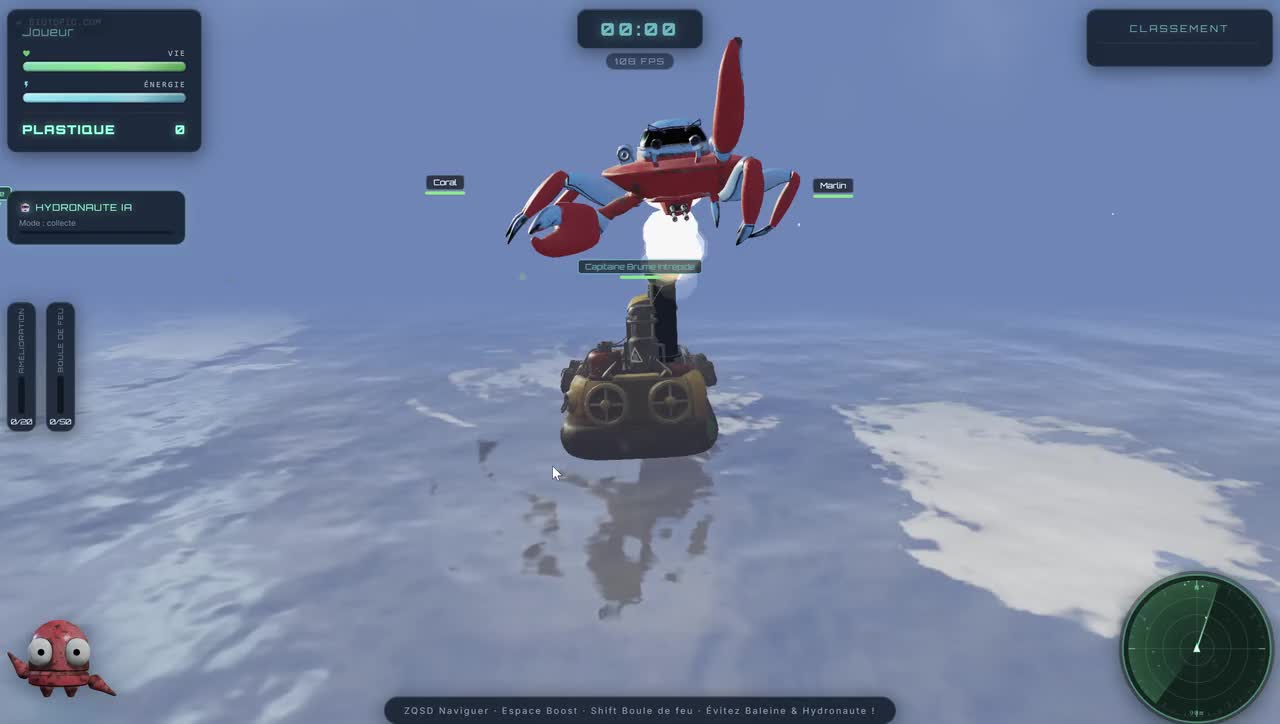
A game first
The idea fits in one line: a steampunk river world, one player against the AI, three minutes to collect as much plastic waste as possible, and whales to avoid. It had to be fun before it could be useful.
It had two reasons to exist: to present the project in some other way than a brochure, and to gather real navigation decisions made by people. We presented it in Nantes, with the City of Nantes and Plastic Odyssey, then at London Climate Week.
What the game records
Beneath the surface, every run anonymously records the player's piloting decisions: trajectory, avoidance, collection priority. These observation-action pairs form an experimental corpus of navigation decisions.
One limit, stated plainly: this data complements our real-world trials. On its own, it is not enough to train or validate an autonomous system. Publication of the corpus, with a documented schema, is planned for 2027.
Player data and boat telemetry are kept separate, and handled in line with the GDPR.
What it teaches us
A person does not steer like an autopilot. They anticipate, hesitate, cut corners, turn back for one more piece of waste, swing round a whale too early or too late. Those movements, very different from a computed route, are exactly what we want to understand.
So the game is our model: watching how people react to an obstacle, a priority, a time limit — and comparing those choices with our surface drone's. On the research side, behavioural learning from this corpus is planned for 2027.
Play
Trashure Island runs in the browser: play. The research protocol is described on the Research page.